Subterranean termites require continuous soil moisture to survive, which makes foundation interfaces in coastal canyons and irrigated landscaping high-risk zones across San Diego County. Unlike drywood termites that…
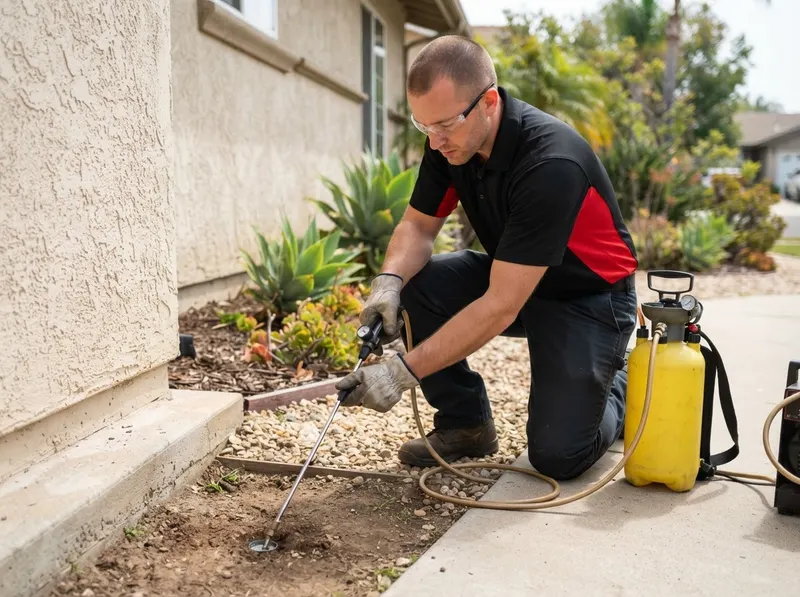
Subterranean termites require continuous soil moisture to survive, which makes foundation interfaces in coastal canyons and irrigated landscaping high-risk zones across San Diego County. Unlike drywood termites that live entirely within seasoned structural lumber and require whole-structure fumigation or spot injections, subterranean colonies live underground and build vertical mud shelter tubes across concrete stem walls, grade stakes, and plumbing penetrations to reach subflooring. An exterior perimeter treatment halts this upward migration. A standard residential installation requires digging a 6-inch by 6-inch trench directly against exterior foundation walls, applying 4 gallons of termiticide solution per 10 linear feet into the trench, and backfilling the treated soil. Where flatwork concrete abuts the structure, such as driveways, patios, and walkways, specialists drill half-inch holes spaced 12 inches apart through the slab to deliver termiticide to the hidden soil beneath before sealing each hole with hydraulic cement.
Soil composition across San Diego directly determines whether a trench-and-rod liquid barrier or an in-ground bait station array is the appropriate intervention. Dense, expansive clay profiles throughout Tierrasanta, Clairemont Mesa, and Scripps Ranch restrict liquid dispersal, making deep pressure rodding and slow-acting in-ground cellulose bait stations advantageous for intercepting workers before they reach stem walls. In sandy, porous soils common to Ocean Beach, Pacific Beach, and Point Loma, liquid non-repellent termiticides saturate evenly, binding directly to mineral particles to create an undetectable transfer zone. Termites pass through this treated strip without avoidance, grooming each other and transferring the active agent throughout the subterranean nest until the entire colony collapses over a period of 60 to 90 days.
Choosing a perimeter soil barrier over localized indoor foaming involves balancing disruption against perimeter longevity. Interior foaming addresses an isolated emergence inside drywall but leaves the subterranean highway under the slab open to ongoing secondary attacks. A comprehensive exterior barrier shields the entire footprint, though it involves physical soil displacement and concrete drilling along exterior walkways. Homes built with crawlspaces in historic neighborhoods like North Park, Hillcrest, and La Jolla often require combined exterior trenching and sub-area perimeter treatment along interior pier pads. Standalone hillside residences in Mira Mesa with zero lot lines or steep drainage swales require bait monitoring arrays spaced every 10 to 15 linear feet to maintain protection without disturbing structural retaining walls or running off into storm channels.
Every job gets a firm, written price after a free on-site visit.
Tell us about your subterranean termite perimeter defense job in San Diego and we'll send a clear, written quote, usually the same day.
 Pacific Cedar Pest Control