Coastal marine layers and mild winter temperatures across San Diego County allow flea and tick populations to breed outdoors throughout the calendar year without a hard winter freeze. Properties in canyon-adjacent…
Coastal marine layers and mild winter temperatures across San Diego County allow flea and tick populations to breed outdoors throughout the calendar year without a hard winter freeze. Properties in canyon-adjacent communities like Tierrasanta, Scripps Ranch, and Clairemont Mesa experience regular wildlife intrusion from brush rabbits, raccoons, and coyotes that drop gravid parasites into tall turf and dry brush perimeters. Near coastal zones such as Pacific Beach, Ocean Beach, and Point Loma, sustained ambient humidity between 65% and 80% creates stable microclimates in shaded ivy and mulch beds, supporting uninterrupted flea pupae emergence.
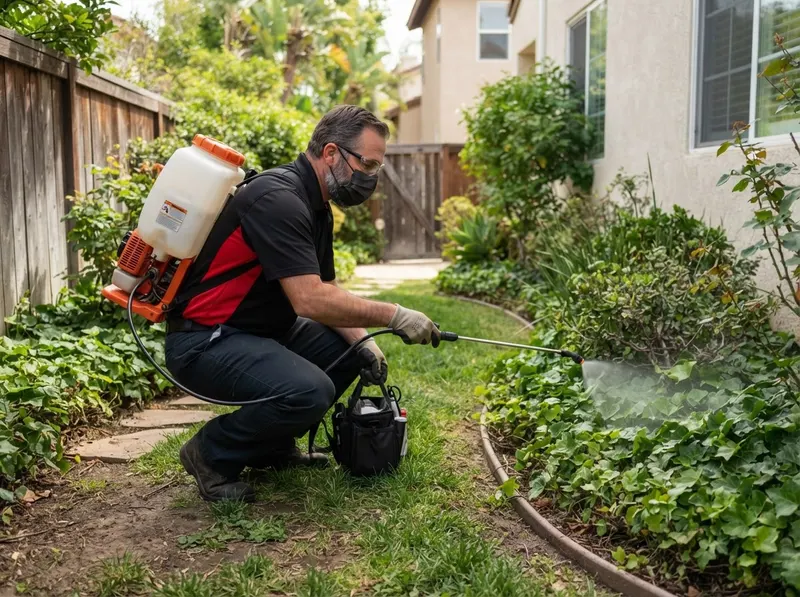
Flea and tick yard barrier sanitization targets reproductive harborages rather than dispersing unguided broad-spectrum sprays across exposed, sunlit concrete where parasites cannot survive. The treatment integrates an insect growth regulator (IGR) with microencapsulated adulticides. Liquid applications coat the lower 2 to 3 feet of exterior fencing, foundation perimeters, and shaded underbrush beneath deck structures. Granular formulations penetrate thick turf canopies down to the soil thatch layer where organic debris shelters flea larvae from direct sunlight. Once dry, the barrier remains bonded to vegetation surfaces to break the 21-day flea development cycle.
A common misunderstanding is assuming that a topical veterinarian flea medication on a domestic dog or cat resolves an outdoor environmental reservoir. While topical animal medications kill biting adults on the host, pupae lying dormant in San Diego yard soils continue emerging for months, resulting in re-infestation every time an animal steps outside. Yard sanitization addresses the environmental reservoir directly. If an infestation is confined to an indoor rug or kennel, interior vacuuming and localized spot treatments suffice; if dogs or cats scratch immediately after spending time in outdoor grass, comprehensive yard barrier sanitization is the appropriate operational match.
Properties bordering natural reserves, such as homes along Torrey Pines State Natural Reserve or canyon trails in North Park and Hillcrest, carry higher tick migration risks. The standard limitation of outdoor yard sanitization is heavy precipitation: standing water from rare heavy coastal storms can dilute applied residual barriers before they bind to soil particles. Consequently, applications are timed during dry surface windows to ensure full adherence. Treatments operate on a standalone, single-service basis, providing transparent resolution without locking homeowners into recurring subscription agreements.
Every job gets a firm, written price after a free on-site visit.
Tell us about your flea and tick yard barrier sanitization job in San Diego and we'll send a clear, written quote, usually the same day.
 Pacific Cedar Pest Control